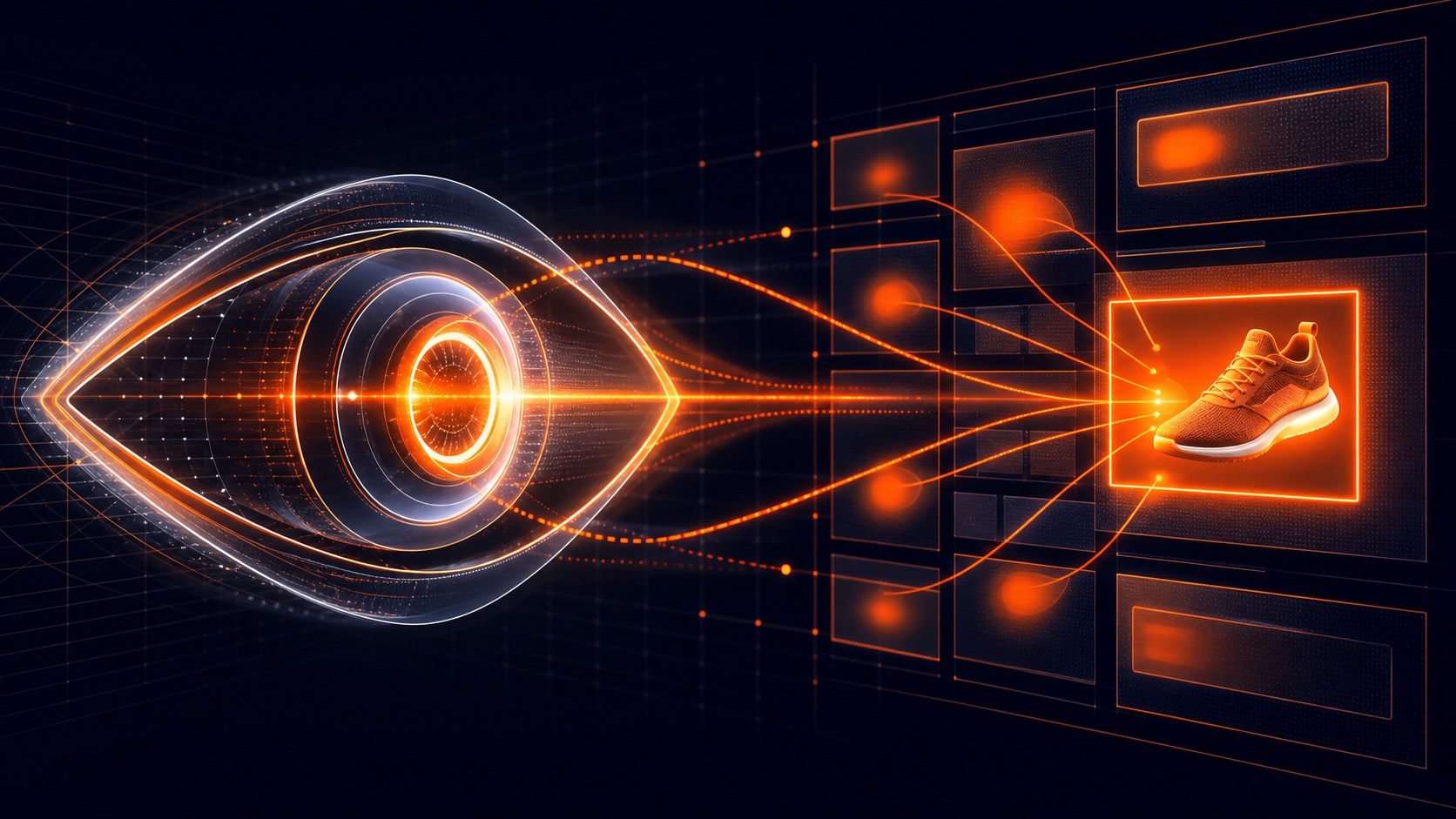
Clicks, CTR and ROAS all describe what happened after an ad was seen — none of them measure whether it was actually looked at. Attention is now its own discipline, with its own vendors and, since November 2025, its own IAB/MRC measurement standard built with Amazon Ads, Google, Meta, Nielsen and Procter & Gamble at the table. Put real ads under a $20,000 Tobii eye tracker and the heatmaps — warm where the eye lingers, cold where it never lands — expose exactly why some creative works and most of it quietly doesn't. The underlying reason is uncomfortable: human vision isn't a camera. We sample a tiny foveal spot and the brain fills in the rest, so your audience is never absorbing the whole ad — only glancing at a fraction of it.
The vampire effect steals your own sale
Put a face in an ad and the eye goes straight to it — wired-in behaviour, and usually an asset. Except when the face is more interesting than the product. Researchers call this the vampire effect: a beautiful model or celebrity drains the attention the product needed. It isn't folklore. The foundational 2015 study in the International Journal of Research in Marketing ran experiments with 4,970 respondents and found brand recall fell when a famous face fronted the ad — unaided recall dropped to 21.2% with a celebrity endorser versus 26.4% with an unknown model of equal attractiveness. The star cannibalises the thing you paid to advertise.
The fix shows up on the heatmap of an ING bank ad starring one of Germany's most famous basketball players: his eyeline runs straight to the ball, and the ball sits right in front of the logo. A 2014 Frontiers in Psychology study measured this gaze-cueing effect directly — an averted gaze toward the product produced a near five-fold increase in dwell time versus a model staring straight at the camera. Use a face, but make it look at what you're selling.
One guardrail from the same research: the vampire effect shrinks under high endorser–brand congruence, so a famous face is safe only when it makes obvious sense for the product. A basketball legend fronting a sports-adjacent banking app clears that bar; the same face selling mattresses would not.
Guide the eye, or lose it to "the cups"
Attention isn't just captured, it's routed. A simple product shot with one arrow pointing from the centred product to the price tag reads as "perfect" on a heatmap — because the price sits close enough that the eye never has to leap. Every leap between disconnected elements is attention leaking out of the frame.
The counter-example is a pens ad where a genuinely strong idea — viewers naturally follow the pen that writes — gets buried under colourful nails, rings and dense low-contrast text competing for the same one or two seconds. Practitioners nickname this clutter "the cups": too many moving elements shouting at once. The heatmap shows eyeballs scattered everywhere except the message. A split-screen mattress ad is worse still: the gaze bounces between two zones and never settles on either, and split screens carry no sequencing to tell the eye which zone matters first.
When you highlight everything, you highlight nothing.
Active attention is a fixed, scarce budget. Two moving elements don't double your impact — they split a finite pool and halve the odds either one lands.
You get two seconds, and no sound
In its March 2026 attribution update, Meta reported that 46% of online purchase conversions with Reels now happen within the first two seconds of attention on a video ad — and cut the "engaged view" threshold from ten seconds to five on that basis. Creative-analytics vendors Vaizle, AdManage.ai, AdSights and Coinis converge on the same physics from the performance side: a 20–25% three-second "hook rate" is baseline, 30%+ is strong creative, and under ~15–20% is a failing opening frame.
Layer on Sharethrough's finding that 75% of people keep their phone on mute even while watching video, rising to 85% of Millennials — and that most feed platforms autoplay silently by default. Text that can't be read fast enough isn't read at all: "yellow on white" and low-contrast captions recur across these heatmaps as the exact spot where viewers waste the two seconds they had, re-reading instead of absorbing.
This is why attention pays off in money, not just theory. Adelaide's 2026 Outcomes Guide — 60 case studies across 16 industries — found high-attention placements delivered a 33% average lift in upper-funnel brand KPIs and a 53% increase in lower-funnel conversions and sales. Attention isn't a vanity metric sitting next to CTR; it's the metric CTR was always trying to approximate.
What Oura gets right
The cleanest heatmap in the whole set belongs to smart-ring brand Oura: product centred, no competing elements, one clear message. When Oura's ads show text, they highlight exactly one word in a different font — and the heatmap confirms that word gets looked at more than the rest. One deliberate emphasis instead of ten accidental ones.
Two more patterns repeat and map onto modern hook theory. Sticky notes read as a human, hand-written interruption in an algorithmic feed — a genuine pattern interrupt. And sequencing — revealing a message in a deliberate order rather than all at once — is the time-domain version of the arrow: instead of guiding the eye across space, you guide it across the timeline, so the viewer is never asked to choose between two things in the same instant.
Novelty helps too, but only if it's routed. A protein-brand ad staging someone doing push-ups with the product on their back, or a POV meme format fronted by a well-known streamer, both earn the thumb-stopper reaction — oh, what's that? — and then the composition carries that first glance straight onto the brand. Novelty buys the first second; the layout still has to spend it.
AI just made the lab cheap
The Tobii rig behind these heatmaps costs around $20,000 and needs a lab. In 2026, predictive-attention tools have made that scarcity mostly obsolete. Neurons reports its AI-generated heatmaps are statistically equivalent to eye-tracking data from 100–150 real people, with over 95% accuracy, trained on 20,000+ participants. Attention Insight claims up to 96% accuracy from 5.5 million real fixations, with no human subjects required.
The caveat: these tools model bottom-up salience — where contrast, faces and motion pull the eye in the first instant. They're weaker on top-down attention, the meaning that decides whether a viewer keeps watching after that first fixation. A predictive heatmap will tell you the logo went unseen; it won't tell you whether the joke landed. Pair the design literacy in this piece with a predictive heatmap on every draft, then still watch hold rate once the ad is live.
The pre-flight checklist
Six things a creative team can check before any ad ships:
- Leash the vampire effect. If a face appears, make it look at the product, not the camera.
- Route the eye on one path. Arrows, eyelines and sequencing beat ten competing shouts.
- Keep related elements close. Price tags, CTAs and logos near the focal point — every leap leaks attention.
- Make the brand visible inside 1.5 seconds. A logo parked in a cold corner effectively isn't in the ad.
- Design for sound-off. High-contrast captions, three skimmable bullets instead of a text block.
- Cut fast, but not too fast. Sub-one-second cuts prevent any single fixation from doing its job.
Think before you create your content. Think about what you want them to focus on — guide the attention, don't distract the viewer.
Attention is the one input every other metric depends on, and it's now cheap to measure. The teams that win the feed will design the heatmap first and let the clicks follow.
EcomExpo 2026 — SCALE or FAIL
Creative, attention and conversion are exactly what our speakers are unpacking live on October 1 at Tech Zity, Vilnius. Three stages, an expo hall, hands-on workshops, and the first-ever EcomExpo Awards. Late Bird tickets are €300 — the final release.
Get your ticket — €300Late Bird €300 · Group (4+) €180/person · October 1, Samsung Conference Center, Tech Zity, Vilnius