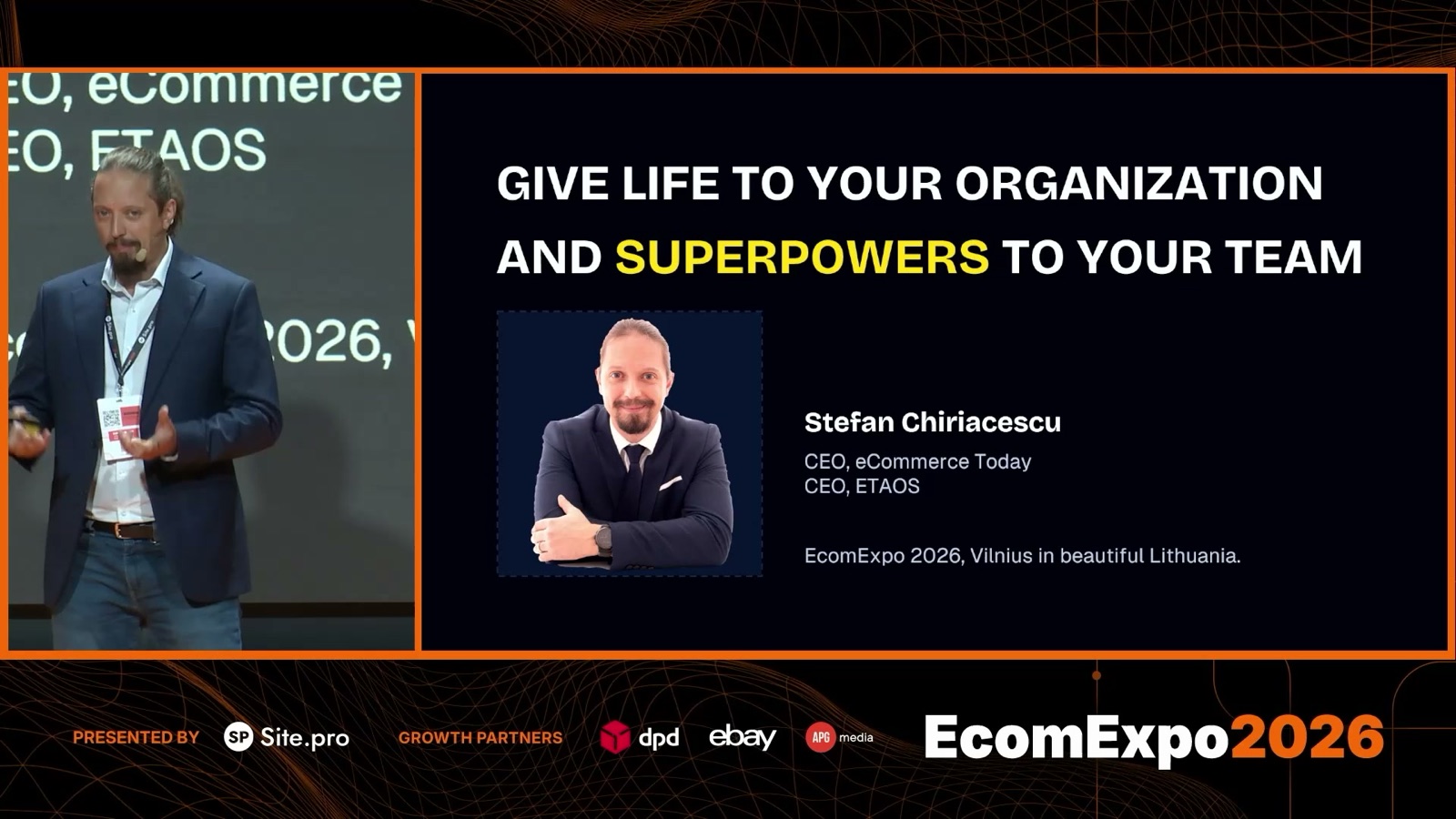
From the EcomExpo 2026 stageBased on the talk “Give Life to Your Organization and Superpowers to Your Team” by Stefan Chiriacescu (Founder, Ecommerce Today) — watch the full talk.
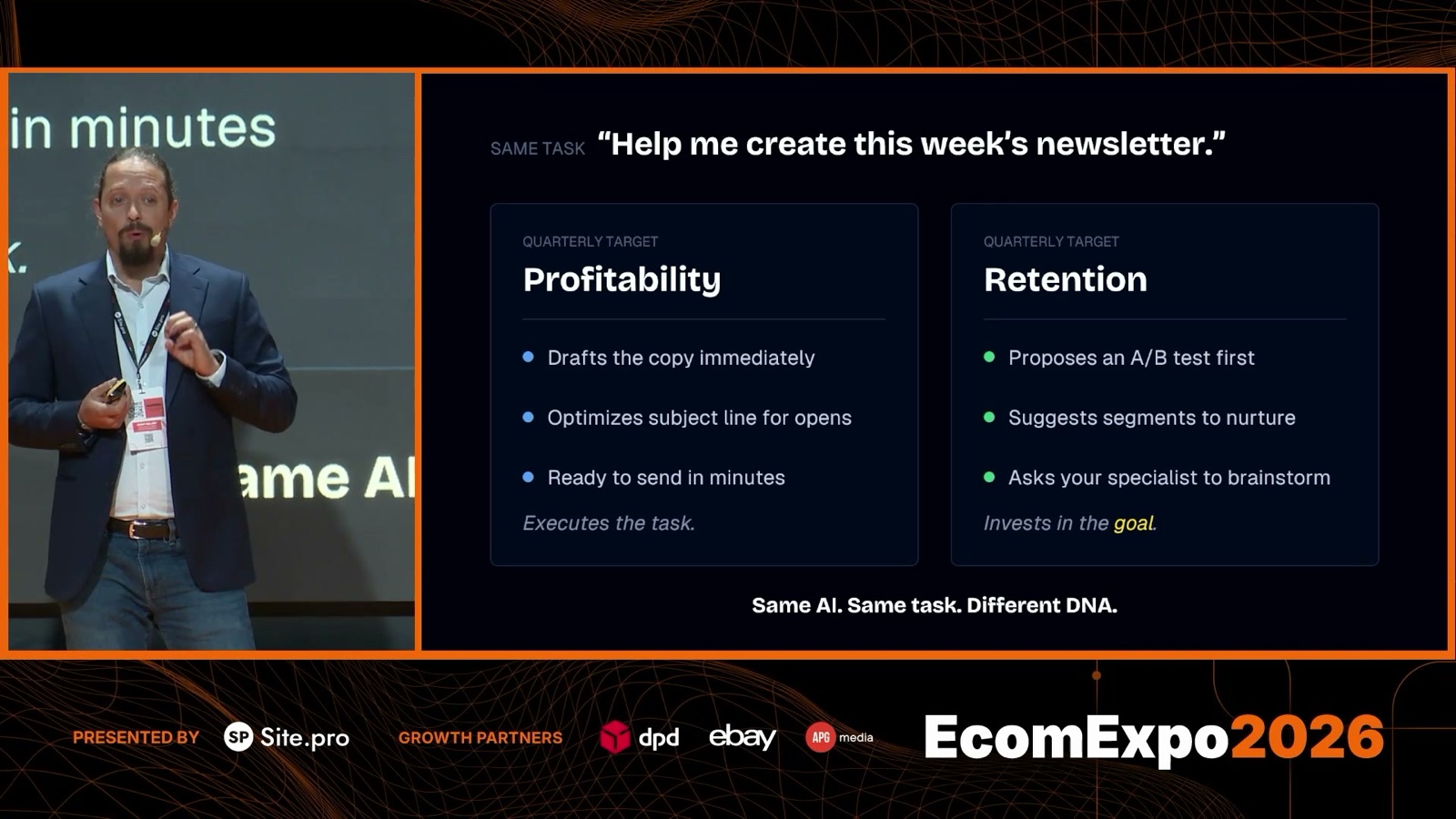
Twelve minutes into the opening keynote of the Deep Dive stage, Stefan Chiriacescu put one prompt on the screen: “Help me create this week’s newsletter.” Then he showed two answers to it. Under a quarterly target of profitability, the assistant drafts the copy immediately, optimises the subject line for opens and has something ready to send in minutes. Under a quarterly target of retention, the same assistant proposes an A/B test first, suggests segments to nurture and asks the specialist to brainstorm. The slide’s caption: “Same AI. Same task. Different DNA.”
Most e-commerce teams that use ChatGPT, Claude or Gemini every day have already done the obvious setup work. They have pasted in a tone-of-voice guide, a few customer personas and maybe a product catalogue. That setup makes the output sound like the brand. It does not tell the assistant what the business is trying to achieve right now.
Our position is simple. The single most useful piece of standing context you can give an AI assistant is the company’s current quarterly goal, written in plain language and updated every quarter. Brand voice is table stakes. A team whose AI tools do not know the quarter’s priority is producing goal-blind work at scale, and the speed of that work makes the problem bigger, not smaller.
Stefan Chiriacescu’s three layers of context
Chiriacescu runs Ecommerce Today, a Romanian e-commerce agency he says now has 33 employees, and the team built its own organisational operating system, ETAOS, which he demonstrated on stage. He also offered to help other organisations build theirs, so he has a commercial interest in the idea that companies need a structured context layer. Keep that in mind; the core of his argument does not depend on buying anything, and he gave the templates away.
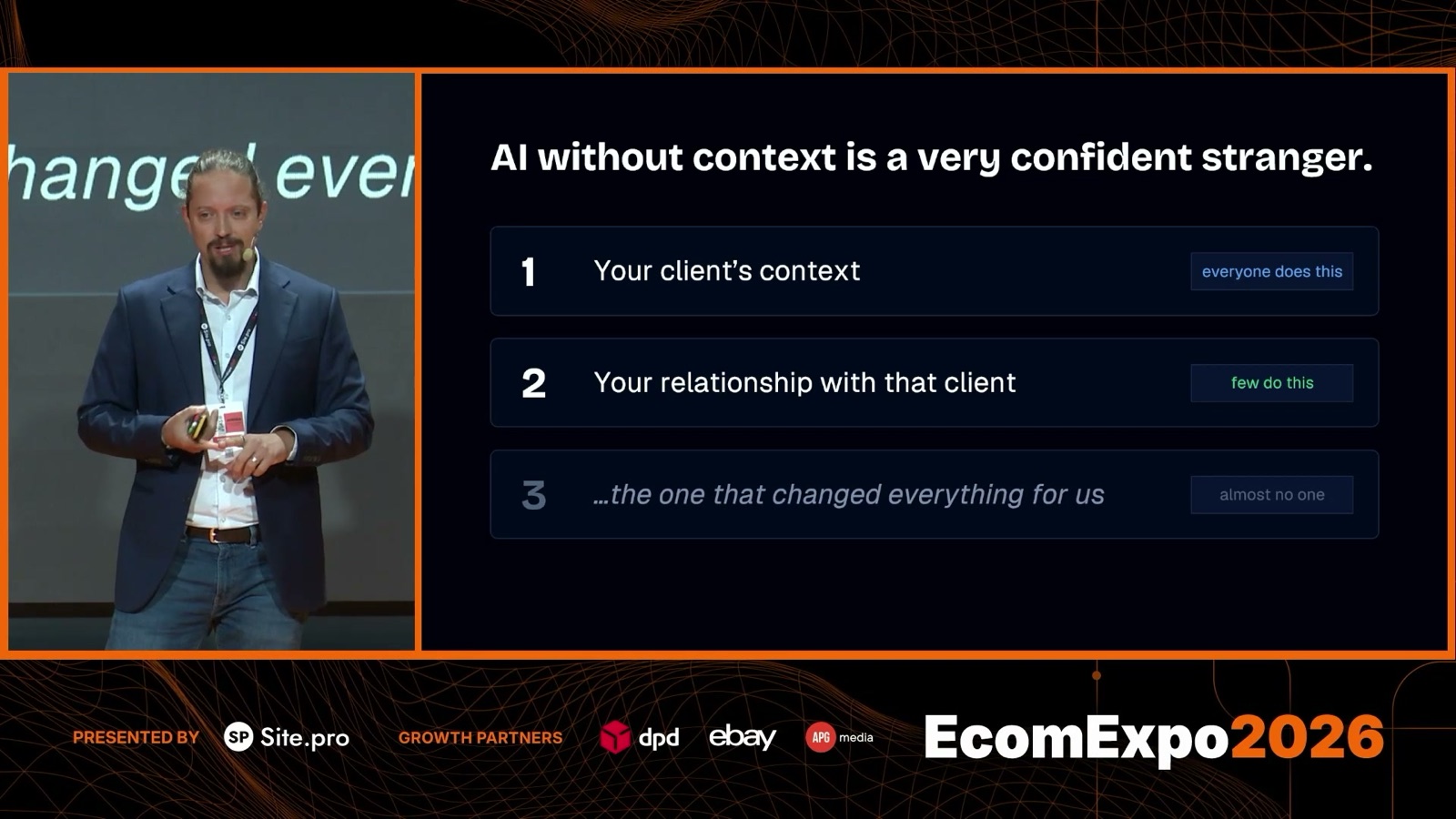
His framing starts with a line that sums up the problem:
“AI without context is a very, very confident stranger.” Stefan Chiriacescu · 08:56
He then described three layers.
- The client or customer. Who they are, what they like and how to talk to them. On his slide this layer was tagged “everyone does this”.
- The relationship with that client. When the work started, the wins, the losses, the friction, what the client likes about the collaboration and what they don’t. Internally his team keeps this in a “client intelligence sheet” that is updated with monthly reports. The slide tagged it “few do this”.
- Organisational DNA. Mission, vision, core values, resources and quarterly goals. The slide’s tag: “almost no one”.
The quarterly goal is where the argument turns practical. “If my AI assistant doesn’t have that context, it’s not going to be able to help my employees to actually determine to work towards that target,” he said (11:20). The newsletter example followed, and he described its effect on his own company in one sentence: “Just one simple thing that we added to our AI context infrastructure changed how our AI assistants interact with our team and with our employees.” (12:28)
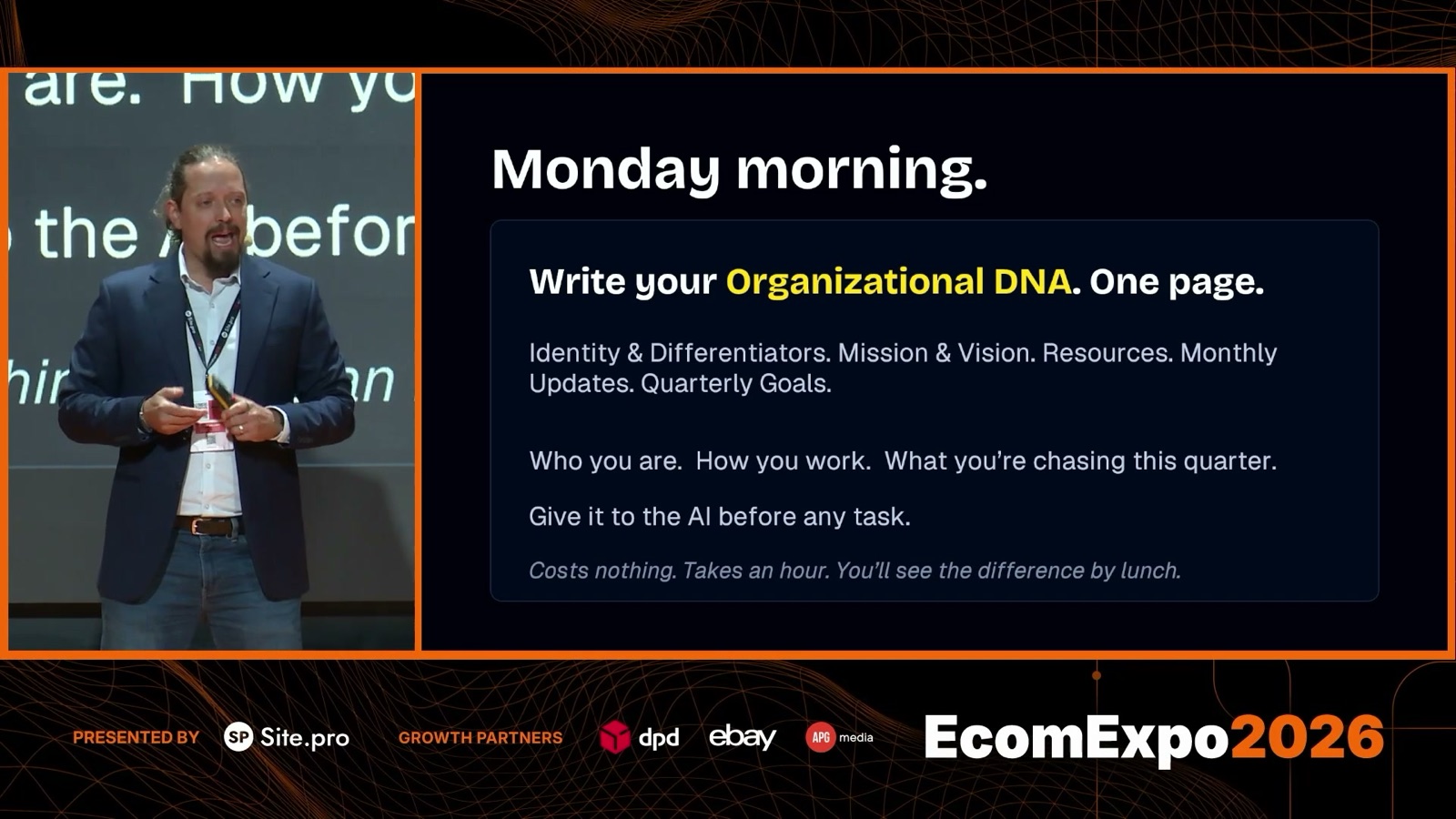
In his closing homework he ranked the parts of the DNA. Write one page covering identity and differentiators, mission and vision, resources (including which software subscriptions you pay for, so the assistant recommends Canva rather than a tool you don’t own), monthly management decisions and quarterly goals. Of these, “the quarterly goals are the ones that take the most precedent and power within your organizational DNA because they impact the responses.” (24:31) The slide promised the exercise “costs nothing” and “takes an hour”.
Two nuances are worth keeping. First, Chiriacescu presented the newsletter comparison as an illustration from his system, not a measured test; we did not see output data. Second, in the Q&A he warned that guardrails in context files only delay the model’s tendency to agree with you if you push it, and recommended using AI as a critic rather than a yes-man.
What the newest data says
AI use is spreading faster than shared direction
The adoption curve in Europe is steep. In 2025, 19.95% of EU enterprises with 10 or more employees used at least one AI technology, up 6.47 percentage points on 2024, according to Eurostat. Lithuania recorded one of the three largest increases in the EU (12.54 points), and the Lithuanian Ministry of the Economy and Innovation, citing the Commission’s 2026 Digital Decade report, puts the share of Lithuanian companies using AI at up to 21%. Marketing and sales is the leading purpose: 34.70% of AI-using EU enterprises applied it there in 2025.
Direction has not kept pace. Microsoft’s 2026 Work Trend Index, a survey of 20,000 AI-using knowledge workers in 10 markets fielded in February to April 2026, found that “only one in four AI users surveyed (26%) say their leadership is clearly and consistently aligned on AI”. The same report attributes 67% of AI’s reported impact to organisational factors such as culture, manager support and talent practices, against 32% to individual mindset and behaviour. Microsoft sells AI tools, so read the framing with that in mind, but the finding points in a useful direction: what the organisation supplies matters more than how clever each employee is with prompts.
The companies that get value aim AI at something
McKinsey’s 2026 State of AI survey (1,719 respondents in 97 countries, fielded May to June 2026) found that 37% of respondents attribute any EBIT impact to AI, essentially unchanged from 2025. Only about 6% qualify as high performers, meaning at least 5% of EBIT comes from AI. About 80% of both groups pursue efficiency, but most high performers also pursue growth or innovation, and they are twice as likely to say senior leaders demonstrate commitment to AI initiatives.
That is correlation from a self-reported survey, not proof that writing down a quarterly goal moves EBIT. It does show where the value sits: in companies whose leadership points AI at specific business outcomes rather than leaving each person to find a use.
Models respond to stated purpose, within limits
The platform makers say the same thing Chiriacescu says, in drier language. Anthropic’s prompting guide tells users to “think of Claude as a brilliant but new employee who lacks context on your norms and workflows” and notes that providing the motivation behind instructions helps the model “better understand your goals and deliver more targeted responses.” The tools already support standing context: Claude’s Projects feature lets teams define project instructions and, on Team and Enterprise plans, share them across the organisation.
More context is not automatically better, though. Chroma’s July 2025 study of 18 large language models found that “model performance consistently degrades with increasing input length”, and that even a single distracting passage reduces accuracy. Anthropic’s own engineering team describes context as “a finite resource with diminishing marginal returns” (September 2025). This is the strongest technical argument for a short goal statement over a 40-page brand book.
| Evidence | What it shows | Strength |
|---|---|---|
| Eurostat 2025: 19.95% of EU firms (10+ staff) use AI | Adoption is broad and rising, fastest in marketing and sales | Official statistics |
| Microsoft WTI 2026: 26% see leadership aligned on AI | Most AI users lack clear direction | Large survey, vendor-run |
| McKinsey 2026: high performers pursue growth as well as efficiency | Value concentrates where AI is aimed at outcomes | Self-reported, correlational |
| Chroma 2025: performance falls as input grows | Context must be short and high-signal | Controlled benchmark, vendor lab |
Where we might be wrong
The best counterargument is that good employees already know the quarter’s goal, so the AI only needs to follow their instructions. If the email marketer knows retention is the priority, they will ask for an A/B test themselves. That is fair for senior people. The evidence on clarity is less reassuring. Gallup’s January 2026 report on US engagement, based on 78,945 workers, found that clarity about what is expected at work fell nine points since 2020, one of the two steepest declines on its index. That is US data, not Baltic, but it suggests that many staff do not carry the goal in their heads. And the same Microsoft survey found 45% of AI users feel it is safer to focus on current goals than to redesign work with AI, which reads as a request for clearer direction.
The second objection is confidentiality. A margin target or a retention problem is sensitive, and pasting it into a third-party tool feels risky. Eurostat found that data protection and privacy concerns were cited by 48.83% of EU enterprises that considered AI but did not use it. This is a real constraint. It argues for business-tier accounts with no training on your data and for writing the goal at the level of direction (“retention over acquisition this quarter”) rather than raw numbers.
The third objection is over-optimisation. A goal in every prompt can push an assistant to bend every task towards one metric. Chiriacescu’s own example shows the cost: under the retention goal the AI answers a simple request with questions and experiments. Sometimes the team just needs to ship the newsletter. A goal statement needs boundaries, such as which tasks are routine and should simply be done.
Finally, the evidence for the specific claim is thin. We found no independent study that isolates the effect of a quarterly-goal statement on AI output quality in commercial teams. The supporting evidence is a demo, vendor guidance and correlational surveys.
Our view
We go a step further than Chiriacescu. He presents organisational DNA as five or six items with the quarterly goal at the top. We think most Baltic e-commerce companies with €1–50 million in revenue should start with the goal alone and add the rest later. Mission and vision statements are usually too abstract to change an output. Brand voice is already handled by the tools most teams use. A short statement of what the company is chasing this quarter, what it is deliberately not chasing, and how success will be measured changes the default answer to many ordinary requests.
The reason is commercial. If the goal is contribution margin, an assistant that suggests a 20% discount campaign is working against you at machine speed. If the goal is repeat purchase rate, an assistant that writes acquisition copy all quarter is wasting your team’s time. Correcting that one prompt at a time is expensive. Correcting it once in a shared instruction is cheap.
We are less persuaded by the “talk to your business” vision of a full operating system, which needs clean HR, client and finance data before it works. The goal brief needs one page and a manager who will update it.
Evidence check
EU AI adoption. Eurostat reports that 19.95% of EU enterprises with 10 or more employees used AI in 2025, with marketing or sales the most common purpose among users (34.70%). This is official survey data; the Lithuanian figure of up to 21% comes from a ministry summary of the Commission’s 2026 Digital Decade report.
Value concentrates in goal-directed companies. McKinsey’s 2026 survey finds 37% of respondents report any EBIT impact from AI and about 6% are high performers who pursue growth or innovation alongside efficiency. The data are self-reported and correlational; they do not show that a goal statement causes the gain.
The newsletter comparison. The profitability versus retention example is Chiriacescu’s illustration from his own system, shown on a slide. We could not test it, and no measured output comparison was presented.
What to do next: write the one-page goal brief
- Write this quarter’s goal in three sentences. What you are optimising (for example repeat purchase rate), what you are explicitly not optimising this quarter, and the one number you will check at the end.
- Add a “just do it” list. Name routine tasks the assistant should complete without turning them into experiments, so the goal does not slow down basic production.
- Put it where every prompt reads it. Use the shared project or custom-instruction feature of the tool your team already pays for (Claude Projects is one example) rather than relying on each employee to paste it.
- Keep it short. Aim for under one page. The research on long inputs suggests that a short, specific brief beats a long document.
- Strip confidential numbers. State direction and priorities, not raw margins, unless you are on a business plan with data controls you have checked.
- Run Chiriacescu’s test yourself. Give the same three everyday requests to an assistant with and without the goal brief, and have the person who owns the goal judge which answers serve it better.
- Update it at the quarterly review. Add the date to the brief and make updating it part of the management meeting where the goal is set, so the AI never works to last quarter’s plan.
The trade-off nobody can automate
Giving AI the quarterly goal is cheap. Choosing the goal is not. Chiriacescu’s slide line “Building got faster and more affordable. Knowing what to build didn’t.” applies here too: an assistant that faithfully pursues a vague or wrong goal will produce more of the wrong work, faster. The goal brief exposes something many companies would rather leave blurry: whether the management team agrees on what this quarter is for.
If you cannot write it in three sentences, the AI is not your biggest problem. If you can, you have just given every tool in the company the brief your best manager would give a new hire.
EcomExpo 2027 — 30 September, Vilnius
This editorial is based on a talk from EcomExpo 2026 — watch the full session. The Baltic’s largest e-commerce conference returns for its 15th edition on Thursday 30 September 2027 in Vilnius. Blind Bird tickets are €150 + VAT until 1 February 2027, before the programme is announced.
Get a Blind Bird ticket — €150Before you write the brief: Run the free Agentic Commerce Readiness Audit — seven dimensions, 60 seconds.
EcomExpo 2027 · 15th edition · 30 September 2027 · Vilnius, Lithuania · Blind Bird €150 + VAT until 1 February 2027
Sources
- Give Life to Your Organization and Superpowers to Your Team (Stefan Chiriacescu, EcomExpo 2026) — EcomExpo / YouTube, 1 October 2026. youtube.com/watch?v=PPDYn-9UMoQ
- Use of artificial intelligence in enterprises — Eurostat Statistics Explained, data extracted December 2025. ec.europa.eu/eurostat
- Lithuania among EU leaders in digital transformation: AI adoption in business has more than doubled — Ministry of the Economy and Innovation of the Republic of Lithuania, 19 June 2026. eimin.lrv.lt
- Agents, human agency, and the opportunity for every organization (2026 Work Trend Index Annual Report) — Microsoft WorkLab, 5 May 2026. microsoft.com/worklab
- The state of AI in 2026: On the road to ROI — McKinsey & Company, 25 August 2026. mckinsey.com
- Prompting best practices — Anthropic (Claude Platform documentation), accessed 18 October 2026. platform.claude.com
- What are projects? — Anthropic (Claude Help Center), accessed 18 October 2026. support.claude.com
- Context Rot: How Increasing Input Tokens Impacts LLM Performance — Chroma (Kelly Hong, Anton Troynikov, Jeff Huber), 14 July 2025. trychroma.com
- Effective context engineering for AI agents — Anthropic Engineering, 29 September 2025. anthropic.com
- U.S. Employee Engagement Declines From 2020 Peak — Gallup, 27 January 2026. gallup.com